Design the coating before you run the coater.
Thin Film Physics is a thin-film optical coating design studio. Build your layer stack, and it runs the real transfer-matrix math — the same characteristic-matrix physics the big design packages use — with a full material + substrate index library built in: wavelength-dependent n and k data for every material and substrate, inside the calculation itself. See reflectance and transmittance across the spectrum before a single angstrom goes down.
One suite, the whole run: DESIGN · INDEX · CRYSTAL · MONITOR · MEASURE · CMM — design the coating, set up the controller, monitor the run, verify the part. Every program $498.99 one-time — no license server, no seat count, no subscription.
Every headline number is verified two ways on the Design Benchmarks page — the app's engine against an independent implementation of the same method, checked against published values.
What it does
Built for coating techs and optical shops by a tech with 20+ years of e-beam, sputtering and PECVD time — Ge, Si and ZnSe included.
Real transfer-matrix physics
Every spectrum is computed with the characteristic (transfer) matrix method in full complex arithmetic — s and p polarization, angles from 0–60°, absorbing layers included. No lookup tables, no faked curves. A bare BK7 surface reads 4.24% R in the app — because that's what it reads on the bench.
Layer stack editor
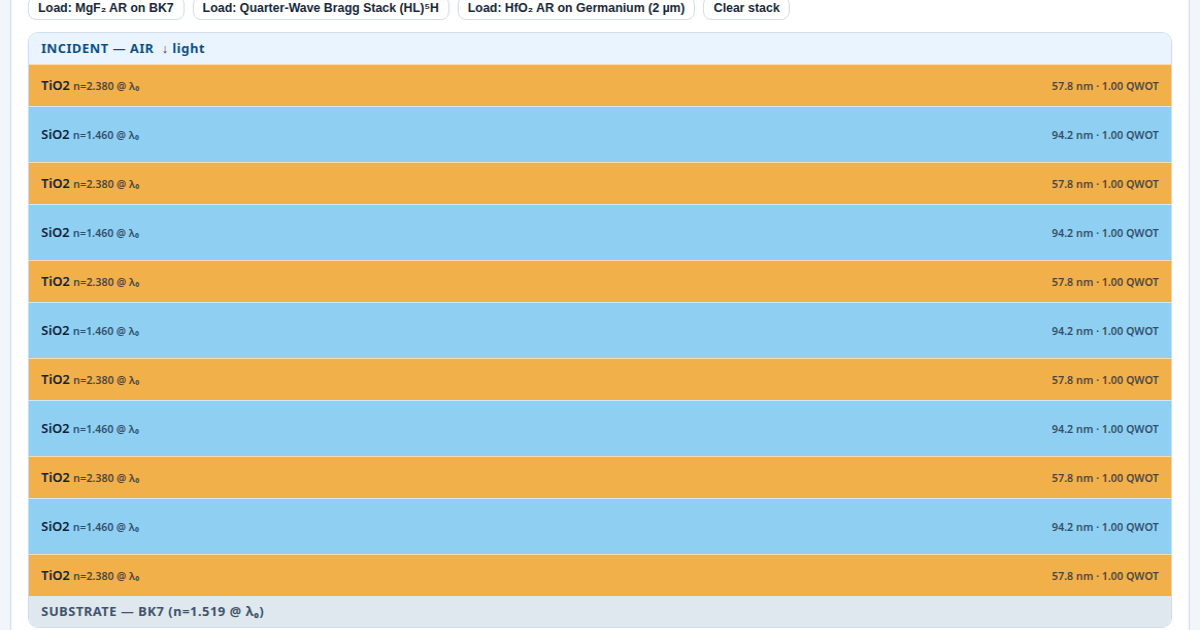
Add, remove and reorder layers. Enter thickness in nanometers or in quarter-wave optical thickness (QWOT) at your design wavelength — the other value follows automatically. The stack diagram draws every layer to scale as you build.
Full index library built in
The whole thing, in the box: wavelength-dependent index tables for every coating material and substrate — n and k from the visible into the infrared, from the standard published Sellmeier equations (Schott BK7, Malitson fused silica and sapphire, Dodge MgF₂) and widely published tabulated data. The engine interpolates the tables at every wavelength, so dispersion is in the math — and you can open the library in the app and read the exact values it's using.
Materials & substrates you actually run
TiO₂, Ta₂O₅, Nb₂O₅, SiO₂, MgF₂, Al₂O₃, ZnS, HfO₂, Si and Ge — absorbing indices included where the material absorbs — plus a custom material with your own n and k. Substrates: BK7, fused silica, sapphire, silicon, germanium and ZnSe — plus Borofloat 3.3, multispectral ZnS, AMTIR-1, AMTIR-2 and Schott KG3 filter glass. Chart from the visible out to 2500 nm.
Loaded with working designs
Starts with designs you can verify against your own experience: a single-layer MgF₂ anti-reflection coating on BK7 (the library indices put R at about 1.25% at 550 nm, down from bare BK7's 4.24%), an 11-layer quarter-wave Bragg mirror, an HfO₂ AR on germanium at 2 µm, and a BBAR-style two-layer design built on the half-wave absentee-layer trick. Works fully offline — your designs never leave your machine.
Capabilities — the depth the majors charge license fees for
The established suites organize their power into calculations, tolerancing, extraction and reports. So does this one — here is the same map, in the open.
Performance calculations
%R and %T spectra by the characteristic (transfer) matrix method in full complex arithmetic — s and p polarization, incidence angles 0–60°, absorbing layers and substrates included, charted from the visible out to 2500 nm. Dispersion is in the math at every wavelength, not pasted on.
Design & refinement
Layer stack editor with thickness in nm or QWOT at your design wavelength, stacks drawn to scale as you build. Start from working designs you can check against your own experience — MgF₂ AR, quarter-wave Bragg mirrors, HfO₂ AR on germanium, BBAR designs on the half-wave absentee-layer trick — then make them yours.
Production analysis & SPC
The run is judged, not just watched: Film Monitor generates the run sheet from the design itself and scores every layer against design-computed SPC limits — in control, watch, or bad cut — with cut points carried on the sheet, so a drifting layer is caught at the chamber, not at final inspection.
Index extraction & reverse engineering
Film Index recovers a film's index from measured spectra — the Swanepoel envelope method on %T, and a transfer-matrix R+T solve at known thickness — and fits Cauchy and Sellmeier dispersion functions to your tables. Film Measure lays the measured spectrum over the design so a failed run tells you by how much, and where.
Run documents & reports
The paperwork a coating run actually needs, generated from the design: the controller-ready setup sheet (Film Crystal), the layer-by-layer run sheet with SPC calls (Film Monitor), the design-vs-measured verification report (Film Measure), and a printable GD&T inspection report (Film CMM).
Materials data, published and checkable
42 materials and the substrate set, from standard published Sellmeier equations and published tabulated n/k — and the engine's numbers are verified two ways on the Benchmarks page. Model values computed from published nk data — absorption as published in the data; a real run peaks lower.
Inside the app — the library, laid out like a working file tree
Everything the studio ships with lives in one Library panel inside the app, organized the way a coating shop organizes its design files — open a folder, get the goods.
All index values are standard published data — published Sellmeier equations and published measurement tables. Film indices vary with deposition conditions, so the app says what every design package says: verify against your own material data before a production run.
One linked workflow — design it, set it up, run it, verify it
The tools work off each other. The design you build in Thin Film Physics becomes the controller setup sheet in Film Crystal, the live run in Film Monitor, and the yardstick in Film Measure — no re-typing the stack at the chamber.
Thin Film Physics
Build the layer stack, run the transfer-matrix math against the full index library, and dial in %R / %T before the chamber is even pumped down.
Film Crystal
Turns the design into a controller-ready setup sheet: per layer, target thickness, density and Z-factor, the crystal frequency drop to expect, and rate and time — printed or copied, ready to key into the controller.
Film Monitor
The quartz-crystal deposition monitor, linked to your design: it loads your saved Thin Film Physics stack and monitors the run layer by layer — live thickness from the crystal (Sauerbrey + Z-factor), percent of layer complete, rate, crystal life, and a run log that checks off each layer as it hits its target thickness. It also generates the run sheet from the design itself and judges each layer against design-computed SPC limits — the full run package, from the design.
Film Measure
After the run, import the measured spectrum and lay it over the design's calculated curve — mean, RMS and max deviation, and a pass/fail call against your tolerance. The run is the design, or you know by how much it isn't.
Try the Design program free — the full engine, in your browser
The majors make you install a demo and wait on a license key. Here the trial is the real calculation: the complete transfer-matrix engine and the full 42-material index library, stacks up to 35 layers, right in your browser — nothing to install, nothing to uninstall. Leave your name, email and company, and the steps to begin arrive by email.
Pricing
Every tool in the line is priced the same way — $498.99 one-time — with an optional Maintenance Plan on top, and both are backed the same way: we maintain the software and provide updates. Or take the whole line at once:
Opening price ends in … — then the package price doubles to $1,999.98.
- Thin Film Physics (Design) · Film Monitor · Film Crystal · Film Measure · Film Index · Film CMM — every tool in the line, one package
- Single-file apps — work offline, no license server, no seat count
- The Maintenance Plan at $99.99/mo comes with the package deal: software updates and custom filter designs to your specifications while you're on the plan (cancel anytime)
- We maintain the software and provide updates
Thin Film Physics — the design studio
- Full Thin Film Physics app, single file
- Works offline, no license server, no seat count
- We maintain the software and provide updates
- Software updates included — and we build filters to meet your specifications
- We maintain the software and provide updates
- One custom design to your spec: $500 without the plan
Film Monitor — the run monitor, linked to your design
- Full Film Monitor app, single file
- Loads your Thin Film Physics design and monitors the run layer by layer
- Works offline, no license server, no seat count
- We maintain the software and provide updates
- Software updates included — and we build filters to meet your specifications
- We maintain the software and provide updates
- One custom design to your spec: $500 without the plan
Film Crystal — the setup sheet, straight from your design
- Full Film Crystal app, single file
- Turns your Thin Film Physics design into a controller-ready setup sheet
- Works offline, no license server, no seat count
- We maintain the software and provide updates
- Software updates included — and we build filters to meet your specifications
- We maintain the software and provide updates
- One custom design to your spec: $500 without the plan
Film Measure — the run, verified against the design
- Full Film Measure app, single file
- Overlays your measured spectrum on the design's calculated spectrum
- Works offline, no license server, no seat count
- We maintain the software and provide updates
- Software updates included — and we build filters to meet your specifications
- We maintain the software and provide updates
- One custom design to your spec: $500 without the plan
Checkout opens with the store listing shortly — the live previews above are the full apps, so what you try is exactly what you get.
Licensing, plainly — and how it stacks up
The legacy suites license progressively: a core, paid enhancements, per-seat keys, and an update service to stay current. Thin Film Physics publishes its whole price on this page and sells the software outright.
| Price | Published, on this page: $498.99 per program, one-time. The whole six-program line as the Complete Package: $999.99 at the opening price. | Legacy suites Quote-based licensing |
| License | Yours to keep. Single-file apps — no license server, no seat count, no activation key to lose. | Legacy suites Per-seat software keys |
| Platform | Runs in any modern browser, works fully offline, on the machine already at the chamber. Your designs never leave your computer. | Legacy suites Windows install |
| Updates | Optional Maintenance Plan, $99.99/mo — software updates plus custom filter designs to your specifications while you're on it. Cancel anytime; the software you bought keeps working. | Legacy suites Annual update service |
| Run package | From the design itself: the design generates the controller setup sheet, the run sheet, the monitor plan and the SPC calls — no re-typing the stack at the chamber. | Legacy suites Runsheet is a paid add-on |
| Proof | Published benchmarks: the engine checked two independent ways against published values, on the Benchmarks page — and a free in-browser trial of the full engine before you pay anything. | Legacy suites Demo on request |
| Built by | A working coating technician — 25 years in manufacturing, 20+ of them coating optics (e-beam, sputtering, PECVD; Ge, Si, ZnSe). The tools are shaped by the floor, not by a product committee. | Legacy suites Software companies |
Support & custom designs
Two ways to get more than the software — the same two the majors offer, without the contract.
Updates + designs to your spec
While you're on the plan: every software update as it ships, and custom filter designs built to your specifications — send the target, get a design computed on the published index data. Cancel anytime; everything you bought outright keeps working.
One design, built for your run
No plan, no subscription: one custom filter design to your specification for a flat $500 — the design, its computed spectrum, and the run package that goes with it. You need it, we build it.
The Line — the full suite
A suite of thin-film programs that work off each other, the way a coating shop actually runs: design the coating, keep its indices straight, set up the controller, monitor the run, then verify the part against the design. Every program is a single-file app — works offline, no license server, no seat count — and every program is priced the same: $498.99 one-time, with an optional Maintenance Plan at $99.99/mo. We maintain the software and provide updates.
Programs
| DESIGN | Thin Film Physics — designs and optimizes thin-film coatings. Layer stack editor, real transfer-matrix spectra, AR / Bragg / BBAR design from the visible to the infrared.$498.99 one-time · Maintenance Plan $99.99/mo | Live Open the preview → |
| INDEX | Film Index — maintains the dispersive index files and functions the whole suite calculates with: edit, plot and store n,k tables (the 42-material published library built in), fit Cauchy and Sellmeier dispersion functions to a table, and recover a film's index from measured spectra — the Swanepoel envelope method on %T, and a transfer-matrix R+T solve at known thickness.$498.99 one-time · Maintenance Plan $99.99/mo | Live Open the preview → |
| MONITOR | Film Monitor — converts your design into a live run: loads the saved stack and watches the quartz crystal layer by layer — Sauerbrey thickness with Z-factor correction, percent of layer complete, rate, crystal life, run log.$498.99 one-time · Maintenance Plan $99.99/mo | Live Open the preview → |
| CRYSTAL | Film Crystal — converts your design into a deposition-controller setup sheet: per layer, target thickness in nm and kÅ, density and Z-factor, the crystal frequency drop to expect, rate and time — printable, or copied as text, ready to key into your controller.$498.99 one-time · Maintenance Plan $99.99/mo | Live Open the preview → |
| MEASURE | Film Measure — verifies the run: import the measured spectrum off your spectrophotometer and it overlays the design's calculated spectrum, computes mean / RMS / max deviation, and calls pass or fail against your tolerance.$498.99 one-time · Maintenance Plan $99.99/mo | Live Open the preview → |
| CMM | Film CMM — plans and evaluates coordinate measurement: build the part from nominal features (point, line, plane, circle, cylinder, sphere), align it 3-2-1 on datums A | B | C, run a simulated probe measurement with tip-radius compensation, and get least-squares fits, GD&T checks — flatness, circularity, cylindricity, true position, perpendicularity — and a printable inspection report. Exports standard DMIS programs and imports measured point data back for evaluation; an offline programming and evaluation station, no machine connection.$498.99 one-time · Maintenance Plan $99.99/mo | Live Open the preview → |
| BENCHMARKS | Design Benchmarks — the verification page: standard designs computed twice — by the Design app's engine and by an independent implementation of the characteristic-matrix method — and checked against published values, plus an infrared spectrophotometer plot (ZnSe AR on germanium, 1–25 µm) on extended published index tables. | Live Read the benchmarks → |
Free trial: the Design program is free to try — the full engine and the complete index library, up to 35 layers, right in your browser. Open the free trial →
Development modules
| BASIC | The pocket calculators — bare-substrate reflectance and the QWOT ⇄ nm converter — running on the same library indices as the design engine. | In the design app Open → |
| Workbook | Your saved designs and calculations — the working file that DESIGN, MONITOR, CRYSTAL and MEASURE all read from, stored in your browser. | In the design app Open → |
| Plot | Spectrum charts — calculated %R / %T curves in the design app, and design-vs-measured overlay plots in Film Measure. | Design app · Measure Open → |
| Report Generator | Printable reports — the controller-ready setup sheet from Film Crystal, printed clean or copied as text for the run file. | In Film Crystal Open → |
| Database | ORIGINAL_FILES — your saved designs and custom materials, organized in the app's Library and kept only on your machine. | In the design app Open → |
Checkout opens with the store listings shortly — the live previews above are the full apps, so what you try is exactly what you get.